You Are Not the Only One
Before anything else: the thing you're feeling, or fear you will feel, is documented, expected, and manageable. It is not a sign you made a mistake.
Research on solo travel psychology draws a critical distinction between solitude and loneliness. They are not the same experience, and solo trekkers encounter both, often in the same day. The fear most first-time solo trekkers carry before departure is a particular one: What if I can't handle being alone for two weeks? The reality most trekkers report after their return is that the loneliness they feared rarely arrived in the form they imagined.
What does arrive is something more textured and, in many ways, more interesting: productive solitude, unexpected joy, unexpected flatness, the quitting urge, and, eventually, something that experienced trekkers describe as clarity.
Many people invest heavily in physical and technical preparation before a Nepal trek. The mental game is the overlooked factor. The thin air, rocky trails, and steep inclines are real, but for most trekkers, they are not the make-or-break factor. This post is about what is.
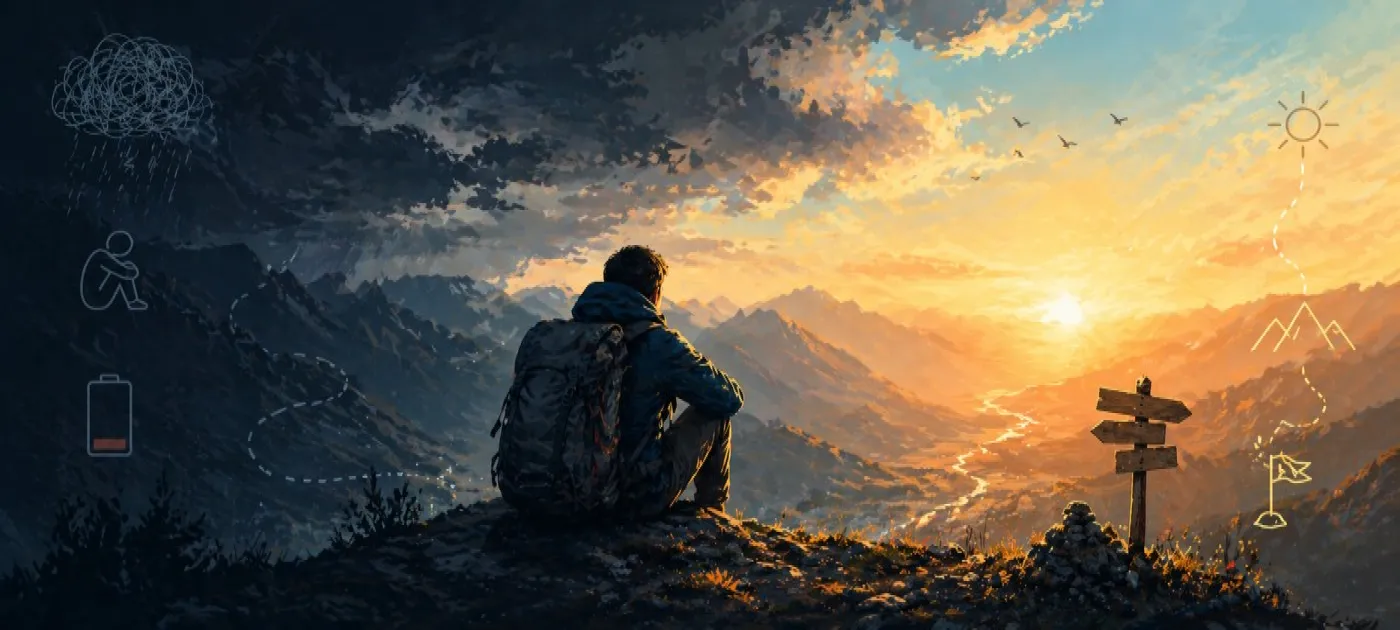
The Psychological Arc: What the Trail Does to Your Mind, Week by Week
Nobody tells you this before you leave, but a long solo trek has a fairly consistent inner shape. Understanding that shape in advance is the most useful preparation you can do.
Phase 1, Days 1 to 3: The Adrenaline Window
Everything is new, everything is beautiful, and your body is producing endorphins from the physical activity. The novelty of suspension bridges, rhododendron forests, and Himalayan peaks breaking through cloud occupies most of your mental bandwidth. Concerns about loneliness feel distant or absent. Social interactions at teahouses are easy, everyone is in the same early-trek buzz.
What to watch: Don't mistake the adrenaline window for the whole trek. Some trekkers push harder in these first days than they should, spending energy they'll need later.
Phase 2, Days 4 to 7: The Adjustment (Where Most People Struggle)
This is the psychological crux. The novelty has partially faded. The body is tired but not yet adapted. The gap between home and the trail is long enough to feel real.
Extended travel without social contact is one of the strongest predictors of difficult loneliness on a long trek, and this is often where it surfaces, not at the beginning. Physical fatigue amplifies emotional states: a manageable feeling of homesickness becomes heavier when your legs hurt and your pack is wet. The romanticised vision of what a solo trek would feel like collides with what it actually feels like on a hard afternoon in cold rain.
The quitting urge often appears here for the first time, more on that in a dedicated section below.
The hardest specific moment most trekkers identify: late afternoon arrivals at teahouses before dinner, when there is nothing to do but sit with yourself. This gap, between arrival and the social buffer of dinner, is when the hardest thoughts tend to visit.
What to watch: Never make big decisions in the late afternoon. This is widely confirmed by experienced trekkers and documented in outdoor psychology. The decision looks different in the morning.
Phase 3, Days 8 to 11: The Trail Rhythm (The Turning Point)
Most trekkers who push through the adjustment phase describe a shift that happens somewhere between day 7 and 10. It is difficult to describe but universally recognised.
The body has adapted: legs are stronger, breathing more efficient, altitude less disorienting. The social landscape of the trail becomes familiar, you recognise faces, know names, have shared reference points. The simplicity of trail life, where your biggest concern is the next step, has a sharpening effect on the mind.
The relationship with your own thoughts changes in this phase. The discomfort of silence gives way to something more interesting, actual reflection, without the constant input of ordinary life. A solo trek strips away distractions and forces a confrontation with your inner voice, your strengths, and your weaknesses. For most trekkers, this arrives gradually, as a quiet recognition rather than a dramatic revelation.
What to watch: Don't mistake this phase's relative ease for a green light to push harder. Sustained effort at altitude accumulates, rest days still matter.
Phase 4, Days 12 to 14+: The Pull Toward Home (and What It Means)
Physical tiredness is real and cumulative, this is normal, not a sign of failure. The mind begins orienting toward return: planning, anticipation, the faces you've missed. Some trekkers find this phase carries a bittersweet quality, wanting to go home and not wanting the trail to end simultaneously.
The clarity many trekkers describe is often most vivid in these final days, when the accumulated stripping-away of ordinary noise has done its work.
One thing rarely warned about: many trekkers experience a period of restlessness and low mood in the first days after returning home. After weeks of trail simplicity, ordinary city life can feel dissonant in ways that take time to settle. This is normal. It has a name, post-trek blues, and we'll come back to it.
Loneliness on the Trail: What It Actually Looks Like (Versus What You Fear)
The version of loneliness most people fear before going is acute and sustained: long stretches of genuine isolation, feeling invisible and forgotten, the kind of loneliness that spirals. This is what makes people hesitant to book.
The version most people actually experience is much more textured.
Productive solitude is the most common experience: walking for hours in silence with only your thoughts and the trail. For most trekkers, this is not painful, it is where the best thinking happens.
Social loneliness, missing specific people, your partner, your closest friend, the people who know you, is real, but it is not the same as abandonment. It is specific and warm, not empty.
Momentary loneliness tends to be brief and situational, typically triggered by beautiful moments ("I wish someone I love could see this") rather than sustained emptiness.
The Trail Is More Social Than You Think
This is the fact that surprises almost every first-time solo trekker. The teahouse common room is a naturally social space. One room, one stove, limited seating. By the time dinner arrives, you know where everyone is from, where they started, and whether their knees are holding up. This happens naturally. You don't have to engineer it.
On any of Nepal's major routes, you'll walk roughly the same pace as a cohort of other trekkers. The same faces appear at the lunch stop, the evening teahouse, the morning departure. Over three or four days, acquaintances become something more, the shared difficulty of the trail creates a particular kind of closeness.
If you're trekking with a licensed guide, you have a companion as well as a professional. Many trekkers who came for the mountains come home talking mostly about their guide.
When Loneliness Is Genuinely Hard
This deserves honesty: for some people, some days, it is genuinely difficult. For individuals with pre-existing mental health conditions or limited experience managing solitude, extended solo travel can exacerbate rather than resolve underlying difficulties. Solo trekking is not a guaranteed cure for anything, and it is worth being honest with yourself about your baseline before you go. This is not a reason not to go, it is a reason to go with self-knowledge and a plan.
Pre-Trek Anxiety: Managing the Fear Before You Leave
The planning phase of a long solo Nepal trek can be intensely anxiety-producing, for many people, more so than the trek itself. The anxiety is primarily about unknowns, and every specific thing you understand before you go is one fewer unknown to fear.
"What if I get altitude sickness?" The honest answer: it can happen to anyone regardless of fitness. The reassurance: standard acclimatisation protocols on well-run treks genuinely work. Diamox is available. Descent is always possible and always the right call if needed. Your guide carries a pulse oximeter.
"What if I can't physically manage it?" The honest answer: physical preparation matters. The reassurance: Nepal's major trekking routes are completed every year by people of every fitness level. The right pace, a porter for your bag, and an honest itinerary change the calculation significantly.
"What if I fall apart mentally?" The honest answer: you will have hard days. The reassurance: hard days are not collapse. Understanding the psychological arc outlined above is the most powerful preparation for this particular fear.
Research in sports psychology consistently shows that adopting a growth mindset, seeing challenges as opportunities to learn rather than threats, transforms how people respond under pressure. In the mountains, where conditions are always shifting, this mental flexibility is as important as physical fitness.
The Quitting Urge: How to Read It Honestly
This is the most important section in the post, and the one most trekking resources skip entirely.
First: the quitting urge is not a character flaw. Every experienced long-distance trekker has felt it. Mental resilience doesn't mean ignoring it, it means understanding it.
There are two very different things that can feel like "I want to quit":
"I want to stop hurting", temporary, emotional, weather-related, fatigue-related. This passes. It is not the same as a genuine call to turn back.
"Something is actually wrong", a safety signal, a medical symptom, a circumstance that has genuinely changed. This requires action, not endurance.
The hard work of a long solo trek is learning to tell the difference.
A Practical Decision Framework
When the urge appears, ask yourself four questions:
- Am I physically safe right now? (If no, act immediately. This is not a mental health question.)
- Am I warm, fed, and sheltered? (If no, address the physical first. The mental often follows.)
- Is this feeling new, or has it appeared before on this trek and passed? (Pattern recognition.)
- Is it late afternoon? (The outdoor psychology rule: never make trail decisions in the late afternoon. Morning almost always looks different.)
If the answers to the first two questions are yes and the feeling has appeared before and passed, sleep on it. Literally. The decision will be clearer in the morning.
Genuine Reasons to Turn Back
This list is short, and it does not include physical tiredness, one or two hard days, missing home, rain, bad food, or a difficult section of trail.
The genuine list:
- Medical symptoms, altitude sickness that is not resolving, injury that is worsening, illness that prevents hydration
- Weather that your guide assesses as genuinely dangerous (trust your guide on this)
- A safety situation that your instincts flag as wrong (trust your instincts on this too)
- Emotional distress that has persisted for more than 48 hours without any improvement and is intensifying
Real Tools for Hard Days
1. The Five-Minute Rule
When the urge to stop is strong, give yourself a five-minute commitment: walk for five more minutes and then reassess. Psychologists working with endurance athletes consistently find that the decision made after five minutes of continued movement is more reliable than the one made standing still. Movement changes mental state. Your mood cares about your movement even when the mountain doesn't care about your mood.
2. Name the Feeling Out Loud (or in Writing)
Journaling during travel is linked to greater self-awareness, it allows deeper understanding of values and emotional reactions, and significantly reduces the weight of accumulated unprocessed experience. On the trail, this is as simple as writing three sentences at the end of each day: what was hard, what was good, what you noticed. Not therapy. A basic tool.
3. Reduce the Frame
When the full trek feels overwhelming, 14 more days of this, reduce the frame to what is actually in front of you. Not 14 days. This section of trail, to the next teahouse. The mountain does not ask you to complete the whole thing right now. It only asks you to take the next step.
4. Find One Human Interaction
On days when the solitude feels heavy, actively seek one genuine exchange, with your guide, with a teahouse owner, with another trekker at dinner. Not forced conversation, just one real one. Maintaining social connection during solo travel is consistently associated with significantly reduced anxiety and low mood, even brief, genuine connection functions as a powerful anchor.
5. The Morning Protocol
Tired bodies produce cortisol. Cortisol amplifies negative emotional states. A simple morning routine, five minutes of breathing before you put on your boots, eating something real before you start walking, consistently reduces the cortisol loading of difficult days. Controlled breathing activates the parasympathetic nervous system and calms the fight-or-flight response. In practice on the trail: three slow breaths before a hard section costs you nothing and changes the chemistry of the next hour.
6. Adjust What This Should Feel Like
Many of the hardest mental states on a solo trek come not from the experience itself, but from the gap between the experience and what the trekker expected. The romanticisation of solo travel in media creates unrealistic expectations, when the reality involves cold rooms, aching legs, and quiet loneliness, the disappointment amplifies the difficulty.
A long solo trek in Nepal is not a continuous peak experience. It is long, sometimes uncomfortable, sometimes deeply boring, and occasionally extraordinarily beautiful. All of that is the same experience. None of it means you're doing it wrong.
Coming Home: The Re-Entry Nobody Warns You About
Many long-trek trekkers experience disorientation, low mood, or restlessness in the first days after returning home. This is documented and normal.
After weeks in Nepal's mountains, returning to city life can produce an almost immediate restlessness, a longing for the simplicity of the trail where your only concern was the next step. The contrast between trail life (physical, simple, present-tense) and ordinary life (sedentary, complex, future-oriented) is a real psychological adjustment.
What to do with it:
- Don't pathologise it, it is a transition, not a problem
- Give yourself 3–5 days before returning to full-intensity ordinary life if possible
- The clarity you found in the mountains does not disappear when you descend, it takes time to integrate
- Take time, in the weeks after return, to ask honestly what the mountains showed you
The trekkers who benefit most from this experience are the ones who carry something back intentionally, rather than expecting the mountain to have done all the work.
A Gentle Note on Mental Health
A long solo trek is not a substitute for professional mental health support, and it is not appropriate for everyone at every time. If you are going through a serious mental health episode, acute depression, anxiety that is currently not well-managed, very fresh grief, a solo trek in a remote environment may add difficulty rather than relief.
This is not to discourage. Thousands of people trek Nepal precisely because they are going through hard things, and the mountains have genuinely helped. But the decision deserves honest self-assessment:
- Are you going toward something (adventure, solitude, challenge) or away from something that needs direct attention?
- Do you have a support structure, someone who knows your plans, can be contacted, and checks in?
- Do you have experience managing your own difficult mental states in unfamiliar environments?
If the answers raise concerns, that's not a reason not to go, it's a reason to build the right support structure before you do.
What the Mountain Gives You (The Honest Version)
The mountains strip away the noise of ordinary life. They leave you with the raw, unmediated version of yourself, your strengths, your weaknesses, the voice in your head when there is nothing else to listen to.
That is the genuine gift of a long solo trek. Not an Instagram moment. Not an empty accomplishment. A recalibration.
The hard days are part of it. The quitting urge is part of it. The loneliness is part of it. They are not obstacles between you and the experience, they are the experience.
If you're considering a solo trek in Nepal and the mental side is what's holding you back, that hesitation is worth taking seriously. And then worth setting aside. The mountain doesn't promise comfort. It promises something more useful.
Ready to Take the Next Step?
Still deciding? If you want to understand what to expect, not just the logistics, but the real experience, our team has guided solo trekkers of every background. We're happy to have an honest conversation before you book.
Ready to go? Browse our solo-friendly trekking packages, all include a licensed local guide, flexible pacing, and a Kathmandu team reachable throughout your trek.
Have questions about the mental side of solo trekking in Nepal? Drop them in the comments below, or reach out to our team directly.