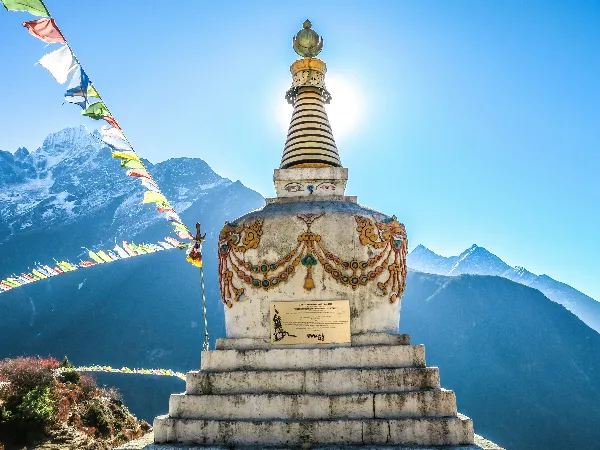
What Makes Manaslu Special? Mountain Overview
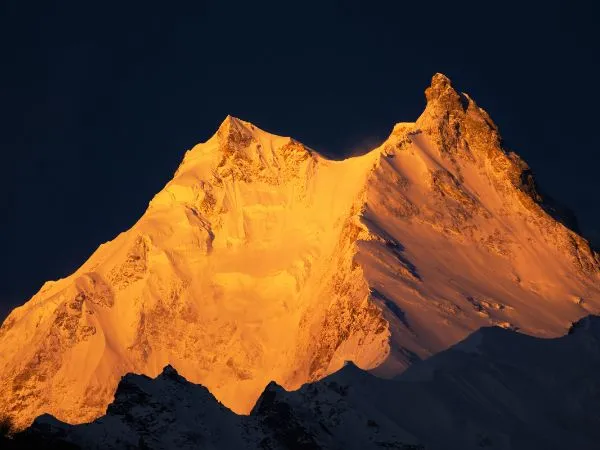
First summited on May 9, 1956 by Japanese climbers Toshio Imanishi and Gyalzen Norbu Sherpa, Manaslu remained the exclusive focus of Japanese expeditions for many years — earning it the informal title of "Japan's mountain." Today the peak welcomes climbers from every nation, yet compared to Everest Base Camp's roughly 50,000 annual visitors, Manaslu sees far fewer expeditions, preserving a sense of genuine wilderness and Himalayan remoteness.
Geographically, Manaslu lies east of the Annapurna range, tucked near the Tibetan border inside the protected Manaslu Conservation Area (MCAP). Its long ridgelines allow feasible approaches from multiple directions, but the Northeast Face route — passing through four high camps — is the standard commercial pathway to the summit and the route used by the vast majority of expedition teams.
"Manaslu is often considered the ideal gateway to the 8,000-meter world — technically demanding yet logistically accessible, with a success rate that rewards well-prepared climbers."
Manaslu At a Glance
- Official Name: Mount Manaslu (also known as Kutang)
- Elevation: 8,163 m / 26,781 ft
- Rank: 8th highest mountain in the world
- Location: Gorkha District, Gandaki Province, Nepal
- Range: Mansiri Himal, Nepalese Himalaya
- First Ascent: May 9, 1956, Toshio Imanishi & Gyalzen Norbu
- Standard Route: Northeast Face (4 high camps)
- Coordinates: 28.6018° N, 84.6208° E
Manaslu Expedition Cost 2027, Full Breakdown
Understanding the true cost of a Manaslu Expedition in 2026 requires separating what different service tiers actually include. Prices span a wide range depending on whether you need full guiding support above Base Camp, oxygen logistics, Sherpa ratio, and what's bundled into the package. Here is a transparent, up-to-date picture:
Base Camp Service $8,760
Kathmandu hotel & transfers
All permits & royalty fees
Trek to Base Camp
BC accommodation & meals
Internal flights
No services above BC
Full Expedition Service $14,600
- Everything in Base Camp tier
- Summit Sherpa guide
- Supplementary oxygen
- High camp tents & food Fixed rope access
- Emergency evacuation support
Premium / Private Expedition $18,000+
- Dedicated 1:1 Sherpa ratio Satellite phone & weather service
- Luxury BC camp setup
- Helicopter options in/out
- Extended acclimatization days
- Private dining tent & cook
What's Typically Included vs. Excluded
| Typically Included |
Typically NOT Included |
| Manaslu Expedition Permit (royalty fee) |
International flights to Kathmandu |
| MCAP & RAP permit |
Travel insurance & emergency evacuation policy |
| Liaison Officer fee |
Personal climbing gear & clothing |
| Kathmandu hotel (pre/post expedition) |
Satellite phone call costs (~$5/min) |
| Jeep / bus to trek start |
Extra porter days & tips |
| Trek to Base Camp (lodge or camp) |
Excess baggage fees on domestic flights |
| Base Camp accommodation & meals |
Additional acclimatization rotations |
| Camping equipment (communal) |
Personal snacks & beverages |
Budget Tip: Always request a written itemised cost sheet from your operator. Confirm whether supplementary oxygen, summit Sherpa, and high-camp food are included, these are the three items most frequently omitted from budget-tier prices advertised online.
Manaslu Expedition Itinerary, Day by Day (2026)
A complete Manaslu Expedition itinerary runs approximately 45 to 55 days, including the trek to Base Camp, acclimatization rotations, summit push, and return. The schedule below reflects the standard autumn expedition timeline used by most reputable operators. Spring expeditions follow the same structure, shifted approximately four months earlier.
Days 1–2 — Arrive in Kathmandu, Briefings & Permit Processing
Elevation: 1,400 m
Arrival in Kathmandu with airport transfer and hotel check-in. During these first days, climbers attend official expedition briefings at the Nepal Mountaineering Association (NMA), complete permit processing, conduct final gear inspections, and purchase any remaining climbing equipment in Thamel.
Day 3 — Drive from Kathmandu to Machha Khola / Soti Khola
Elevation: 700–900 m
A full-day jeep or bus journey of approximately 7–9 hours through the hills and river valleys of central Nepal to the expedition trailhead. Some operators may arrange a domestic flight toward Arughat to shorten the overland journey.
Days 4–14 — Trek to Manaslu Base Camp via Budhi Gandaki Valley
Elevation Gain: 700 m → 4,800 m
The approach trek to Base Camp usually takes 10–12 days and passes through traditional villages including Soti Khola, Jagat, Namrung, Lho, and Samagaon.
Trekkers cross suspension bridges, waterfalls, terraced hillsides, and remote Tibetan-Buddhist settlements while gradually acclimatizing to altitude. An acclimatization day at Samagaon (3,530 m) is strongly recommended before ascending higher.
Days 15–16 — Manaslu Base Camp Arrival & Setup
Elevation: 4,800 m
Arrival at Manaslu Base Camp, located on the lateral moraine above Samagaon. Expedition staff establish personal sleeping tents, dining tents, kitchen areas, shower facilities, charging stations, and communications equipment.
These days are primarily used for rest, organization, and orientation before climbing rotations begin.
Days 17–28 — Acclimatization Rotations (Base Camp to Camp 3)
Elevation Range: 4,800 m → 6,800 m (return)
Multiple acclimatization rotations are carried out progressively higher on the mountain using the “carry high, sleep low” strategy.
Typical rotation structure includes:
- Base Camp → Camp 1 → Base Camp
- Base Camp → Camp 2 → Base Camp
- Base Camp → Camp 3 → Base Camp
These rotations help climbers adapt physiologically to extreme altitude while Sherpa teams establish fixed ropes and stock high camps with oxygen, food, fuel, and climbing equipment.
Days 29–34 — Rest Period & Summit Weather Window
Elevation: 4,800 m
Following acclimatization rotations, climbers remain at Base Camp for recovery and summit preparation. During this phase, expedition leaders monitor detailed weather forecasts while conducting oxygen system testing, equipment inspections, and final summit strategy briefings.
The team waits for the most stable summit weather window before beginning the summit push.
Days 35–37 — Summit Push (Base Camp to Camp 4)
Elevation Gain: 4,800 m → 7,400 m
The summit push generally requires three days to move from Base Camp to Camp 4.
The ascent includes:
- Crossing glacier icefall sections
- Navigating crevassed terrain
- Climbing steep 50–55° snow slopes near Camp 4
Most climbers begin using supplemental oxygen from Camp 3 (6,800 m) onward to improve safety and performance at extreme altitude.
Day 38 — Summit Day (8,163 m)
Elevation: 7,400 m → 8,163 m → 7,400 m
Summit day usually begins between midnight and 2:00 AM.
Climbers ascend for approximately 6–10 hours through the death zone, crossing exposed ridges and steep snow slopes before reaching the true summit of Manaslu at 8,163 meters.
Following the summit, climbers descend carefully back to Camp 4 by early afternoon. This is the most physically and mentally demanding stage of the entire expedition.
Days 39–42 — Descent to Base Camp & Trek Out
Elevation: 7,400 m → 4,800 m → lower valleys
Teams descend progressively from the high camps back to Base Camp. After cleanup and dismantling of expedition infrastructure, climbers begin the return trek down the Budhi Gandaki Valley.
Some operators offer helicopter evacuation or helicopter return flights from Samagaon to shorten the exit journey.
Days 43–55 — Return to Kathmandu, Debrief & International Departure
Elevation: 1,400 m
Final return to Kathmandu by road or domestic flight. Climbers participate in expedition debriefings, summit celebrations, certificate collection, and final logistics before international departure.
Additional buffer days are intentionally included in the itinerary to accommodate weather delays, route conditions, or unexpected summit scheduling changes.
Key Itinerary Flexibility Notes
- Itineraries are always subject to adjustment for weather, individual acclimatization speed, and team condition.
- Autumn expeditions typically depart Kathmandu in early-to-mid September, targeting an October summit window.
- Spring expeditions depart in late March or early April, with summit attempts in May.
- Helicopter transfers from Samagaon are available and significantly shorten return time.
Summit Route, High Camps & Technical Details
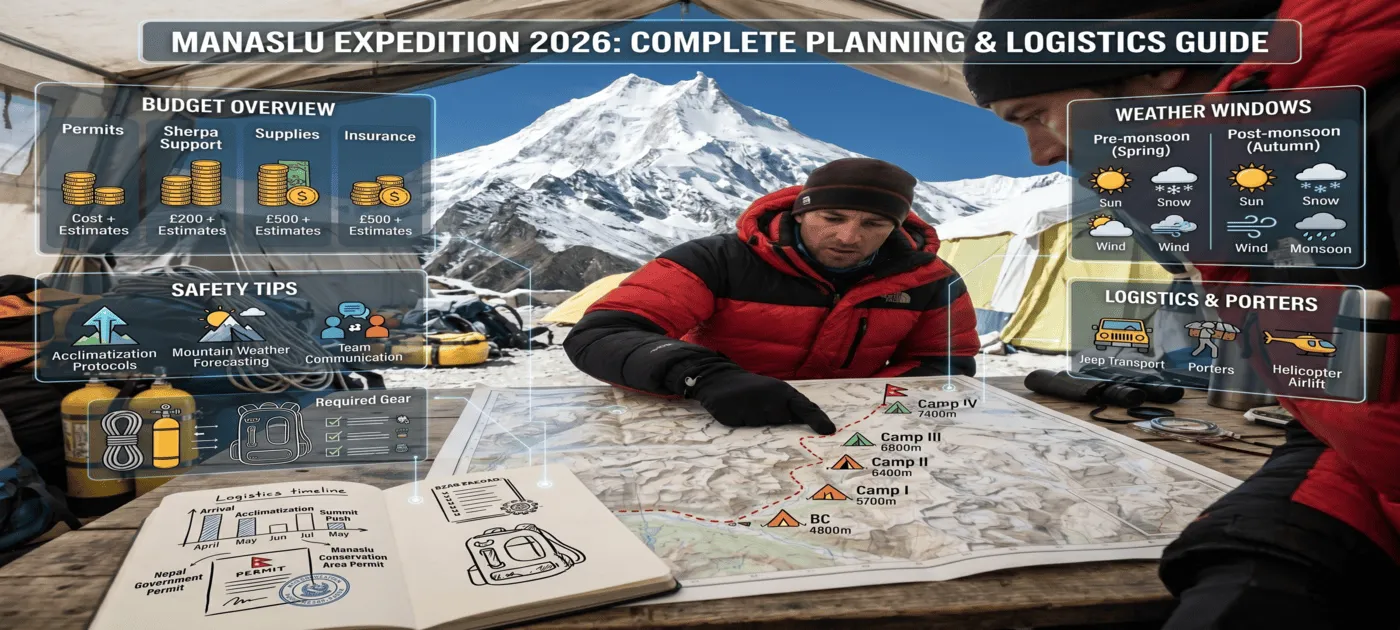
The standard Manaslu summit route follows the Northeast Face, also referred to by some operators as the Southwest Face route. All commercial expeditions in 2026 use this established path, which involves four high camps above Base Camp, fixed rope installations throughout the climb, and multiple heavily crevassed glacier sections requiring careful navigation.
Elevation Profile
| Location |
Elevation (m) |
Elevation (ft) |
| Summit |
8,163 m |
26,781 ft |
| Camp 4 |
7,400 m |
24,278 ft |
| Camp 3 |
6,800 m |
22,310 ft |
| Camp 2 |
6,400 m |
20,997 ft |
| Camp 1 |
5,700 m |
18,701 ft |
| Base Camp |
4,800 m |
15,748 ft |
Camp-by-Camp Route Description
| Camp |
Elevation |
Terrain & Challenges |
Average Hours from Below |
| Base Camp |
4,800 m |
Lateral moraine terrain; rocky but relatively flat campsite area |
Trek access (10–12 days) |
| Camp 1 |
5,700 m |
Glacier entry with crevasse navigation and unstable icefall sections |
5–7 hrs from Base Camp |
| Camp 2 |
6,400 m |
Safer flat terrace above the icefall; risk of heavy snow accumulation |
3–5 hrs from Camp 1 |
| Camp 3 |
6,800 m |
Located below the col to reduce wind exposure; includes short crevasse crossings |
Approx. 3 hrs from Camp 2 |
| Camp 4 |
7,400 m |
Steep 50–55° snow slopes; entry into the death zone; physically demanding climb |
3–4 hrs from Camp 3 |
| Summit |
8,163 m |
Exposed summit ridge with dangerous fore-summit confusion and final snow slopes to true summit |
6–10 hrs from Camp 4 |
Technical Note
Many climbers reach Manaslu’s fore-summit but do not continue to the true summit due to the exposed and technically challenging connecting ridge. Expedition teams should ensure they specifically target the true summit at 8,163 meters rather than stopping at the lower fore-summit.
It is strongly recommended that climbers clearly brief their Sherpa team and expedition leaders about this distinction before summit push day to avoid summit verification issues.
Manaslu Death Rate, Facts, Causes & Safety
The Manaslu death rate is one of the most frequently searched concerns among prospective expedition climbers — and for good reason. Accurate and transparent data is essential for making informed decisions before attempting any 8,000-meter mountain.
Fatality-to-Summit Ratio
Approximate Death Rate: ~2.5%
Based on approximately 90 fatalities and more than 3,750 successful summits recorded through 2025.
| Mountain |
Approximate Fatality Rate |
| Cho Oyu |
Lower than Manaslu |
| Manaslu |
~2.5% |
| K2 |
~24% |
| Annapurna I |
~32% |
Historically, Manaslu has seen around 90 recorded deaths compared to roughly 3,750 successful ascents through 2025. While yearly accident numbers vary depending on weather conditions and route stability, the overall fatality rate of approximately 2.5% places Manaslu among the safer eight-thousanders.
Compared with Annapurna I and K2, Manaslu is dramatically less deadly. However, it still remains a serious high-altitude expedition mountain with objective hazards including avalanches, altitude illness, and extreme weather exposure.
Primary Causes of Death on Manaslu
| Cause |
Highest Risk Zone |
Common Mitigation Measures |
| Avalanche |
All elevations; highest risk between Camp 1 and Camp 3 |
Early morning movement; careful route assessment by Sherpa team |
| Altitude Sickness (HACE / HAPE) |
Above 6,000 m |
Gradual acclimatization; supplemental oxygen; immediate descent if symptoms appear |
| Crevasse Falls |
Glacier sections between Base Camp and Camp 1 |
Fixed ropes; rope teams; experienced Sherpa guidance |
| Exposure & Frostbite |
Camp 3 to Summit; temperatures often −30°C to −40°C |
High-quality layering system; avoid late summit pushes |
| Exhaustion & Disorientation |
Death zone and summit day |
Strict turnaround times; strong Sherpa support; proper pacing |
| Serac Collapse |
Camp 1 approach |
Move efficiently through known danger zones; understand residual objective risk |
Essential Safety Checklist for Manaslu 2026
✅ Prior high-altitude climbing experience on at least one mountain above 7,000 meters
✅ Comprehensive travel and rescue insurance covering helicopter evacuation above 6,000 meters
✅ Supplemental oxygen system with a minimum of 4 oxygen bottles per climber above Camp 3
✅ Strict summit turnaround policy: maximum 2:00 PM regardless of remaining distance to summit
✅ Satellite communication device with continuous weather forecast access
✅ Pulse oximeter carried at all times above Base Camp
✅ Full understanding of HACE and HAPE symptoms; immediate descent remains the only reliable treatment
✅ Climb only with expedition operators employing certified IFMGA or NMA-licensed Sherpas
Final Safety Perspective
Although Manaslu is widely considered one of the more achievable 8,000-meter peaks, climbers should never underestimate the mountain. Most serious incidents occur due to poor acclimatization, delayed descent decisions, unstable weather conditions, or inadequate logistical preparation.
With proper acclimatization, experienced support staff, disciplined summit strategy, and stable weather windows, Manaslu can offer one of the safest introductions to high-altitude Himalayan expedition climbing.
Best Season for Manaslu Expedition 2026
Mount Manaslu is climbed commercially during two primary expedition windows each year, both shaped by the Himalayan weather cycle surrounding the monsoon season.
Seasonal Comparison
| Season |
Typical Dates |
Conditions |
Verdict |
| Autumn 2026 |
September–November |
Stable weather, clear skies, settled post-monsoon snow, lower wind speeds. Slightly busier than spring. |
⭐ Best Season |
| Spring 2026 |
April–May |
Stable pre-monsoon weather, fewer climbers than autumn, slightly warmer lower camps. May can bring unpredictable jet stream movement. |
✅ Excellent |
| Winter |
December–February |
Extremely cold temperatures (−40°C or lower), severe jet-stream winds above 7,000 m, very limited summit opportunities. |
⚠ Expert Only |
| Monsoon |
June–August |
Continuous rainfall and snowfall, high avalanche danger, flooded trails, poor visibility. |
🚫 Not Recommended |
For the Manaslu Expedition Autumn 2026 season, most operators schedule departures between September and October. Early September expeditions often benefit from reduced congestion on fixed ropes and smoother Base Camp logistics, while October departures frequently align with the most stable summit weather windows of the year.
Manaslu Expedition 2027 & 2028 — Planning Ahead
For mountaineers planning a Manaslu Expedition in 2027 or 2028, the overall expedition structure is expected to remain very similar to 2026. Permit systems, route logistics, and expedition operations are not forecast to change significantly.
However, early booking is highly recommended, especially for autumn expeditions, as experienced Sherpa teams and premium Base Camp locations are typically reserved well in advance.
Projected Expedition Windows 2027–2028
Manaslu Expedition Autumn 2027
- Kathmandu departures: September–October 2027
Manaslu Expedition Spring 2027
- Kathmandu departures: April–May 2027
Manaslu Expedition Autumn 2028
- Kathmandu departures: September–October 2028
Advance Booking Recommendations
- Most operators begin accepting reservations 12–18 months in advance
- Expected expedition cost range (2027–2028): USD $9,000–$20,000
- Moderate annual price increases are expected due to logistics and permit adjustments
Important Future Trends to Watch
Nepal’s government has gradually reviewed permit and royalty fee structures for major 8,000-meter peaks. Any future changes to climbing royalty fees are expected to be announced by the Nepal Mountaineering Association and reflected in expedition pricing.
Additionally, the solo Restricted Area Permit regulation introduced in March 2026 is expected to remain in effect, which may increase overall trekker traffic on the Manaslu approach trail.
Frequently Asked Questions, Manaslu Expedition 2026
How much does a Manaslu Expedition cost in 2026?
The Manaslu Expedition 2026 cost ranges from approximately USD $8,760 for a Base Camp Service package to around USD $14,600–$18,000 for a Full Expedition Service that includes summit Sherpa support, supplemental oxygen, and complete high-camp logistics. Premium private expeditions may exceed USD $20,000.
What is the death rate on Manaslu?
The current Manaslu death rate is estimated at approximately 2.5%, based on roughly 90 fatalities compared with more than 3,750 successful summits recorded through 2025. This makes Manaslu significantly safer than Annapurna I or K2, though it still remains a serious high-altitude expedition requiring full preparation and prior experience.
Where is Manaslu Base Camp and how do I get there?
Manaslu Base Camp is located at approximately 4,750–4,800 meters above sea level near Samagaon village in Nepal’s Gorkha District. Most expeditions reach Base Camp via a 10–12 day trek beginning from Machha Khola or Soti Khola through the Budhi Gandaki River valley. Some operators also provide helicopter transfers from Samagaon to reduce return trekking time.
Is Manaslu a good first 8,000-meter peak?
Yes. Manaslu is widely regarded as one of the best introductory 8,000-meter mountains for experienced high-altitude climbers. The standard route is relatively straightforward, fixed ropes are normally established throughout the upper mountain, and logistics from Kathmandu are comparatively accessible. Climbers should still have prior experience on at least one mountain above 7,000 meters before attempting Manaslu.
How long does a Manaslu Expedition take?
A complete Manaslu Expedition generally takes 45–55 days from arrival in Kathmandu to final departure. This includes trekking to Base Camp, acclimatization rotations, summit attempts, weather delays, and the return journey. Helicopter evacuation or return flights can shorten the expedition duration by several days.
What permits are required for the Manaslu Expedition?
Four permits are generally required for a Manaslu Expedition:
- Expedition Royalty / Climbing Permit from the Nepal government
- Restricted Area Permit (RAP)
- Manaslu Conservation Area Permit (MCAP)
- Annapurna Conservation Area Permit (ACAP) if exiting via Dharapani
All permits are processed through a registered Nepal expedition operator.
What is the best season for Manaslu Expedition 2026?
The best season for the Manaslu Expedition 2026 is Autumn (September–October), when post-monsoon weather creates clearer skies, lower wind speeds, and more reliable summit conditions. Spring (April–May) is considered the second-best season.
Most Autumn 2026 expeditions depart Kathmandu in early-to-mid September, with summit pushes usually planned between late September and mid-October.